
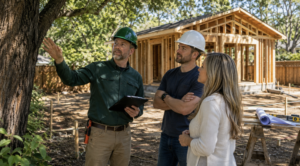
Accessory dwelling units have become an important part of residential construction. Homeowners use them to create rental income, provide private living space for relatives, add a home office, or make better use of an underdeveloped portion of a property. An accessory dwelling unit may be small compared with a primary residence, but the construction process can involve the same serious planning issues found on much larger projects.
One of those issues is the relationship between the proposed structure and the trees already growing on or near the building site. A mature tree may appear to be safely outside the footprint of a detached ADU, yet its roots can extend beneath the excavation area, utility route, driveway, grading zone, or equipment access path. A neighboring tree can also affect the project when its canopy or root system crosses the property line.
That is why an Arborist Report for ADU can become one of the most influential documents in the approval and construction process. It gives homeowners, designers, engineers, contractors, and local officials a clearer understanding of which trees may be affected, how construction activity could damage them, and what practical measures can protect the property while keeping the project moving. 🌳
ADU Construction Begins Below the Ground
Construction drawings naturally focus attention on visible features such as walls, windows, rooflines, setbacks, and finishes. Trees create a different challenge because some of their most important structures are hidden underground. Roots provide support, collect water and nutrients, and help a tree respond to wind and changes in soil conditions. Excavation can remove structural roots, while trenching may cut through a root system in a long, continuous line.
The danger does not end with digging. Heavy equipment can compact soil, stored materials can cover active root areas, and repeated foot traffic can reduce the air and water available to roots. Changes in grade can bury roots too deeply or expose them. Concrete washout, fuel, paint, and other construction materials may also damage soil conditions when site controls are weak.
These concerns matter in a construction market where residential improvements continue to represent a substantial share of building activity. The U.S. Census Bureau’s construction spending reports track residential construction as a major part of the national industry. As property owners invest in additions and secondary living spaces, tree-related planning becomes more important because many of these projects are built within established neighborhoods rather than on cleared development sites.
A Tree Can Affect the Design Before Construction Starts
A professional tree assessment is most useful when it is completed early. Waiting until plans are nearly finished can create expensive redesign work if a protected tree, critical root area, or local preservation requirement conflicts with the proposed layout. Early information gives the design team more room to adjust the building footprint, foundation type, utility connections, drainage plan, or access route.
A report may document tree species, trunk diameter, approximate height, canopy spread, condition, structural concerns, and location. It may identify trees proposed for removal, trees suitable for preservation, and trees requiring further evaluation. The report can also recommend protection zones and construction methods intended to reduce damage.
This information does not automatically stop development. In many cases, it helps the project team find a workable path forward. A slight shift in the building location may preserve an important root zone. A pier-based or specialized foundation may reduce excavation. Utilities may be rerouted around significant roots. Fencing can keep workers and machinery out of sensitive areas.
Construction publications such as Engineering News-Record regularly emphasize the importance of planning, project controls, engineering judgment, and risk management. Those principles apply just as strongly to a backyard ADU as they do to a major commercial project. The scale is smaller, but the cost of an avoidable delay can still be painful for an individual property owner.
Permit Reviews Often Extend Beyond the Building Footprint
An ADU permit application may be reviewed by more than a building department. Depending on the location, planning staff, public works personnel, urban forestry divisions, fire officials, utility providers, and environmental reviewers may all have responsibilities connected to the project. Local rules may apply to protected species, heritage trees, street trees, trees within setbacks, or trees located on neighboring property.
A tree report can provide a consistent source of information for those reviewers. Instead of relying on photographs or broad assumptions, the report offers site-specific observations and recommendations prepared by a qualified professional. This can reduce confusion when the plans show construction close to existing trees.
Current residential construction reporting from Construction Dive reflects the continuing pressure to expand housing supply while managing costs, financing constraints, and permitting realities. ADUs are part of that broader housing conversation. Their relative size does not exempt them from local development standards, and overlooked site conditions can slow a project that initially appeared straightforward.
Tree Protection Must Be Buildable, Not Merely Written
A successful report does more than state that trees should be protected. It provides recommendations that can be translated into site activity. A contractor needs to know where protection fencing belongs, which areas must remain free of equipment, where materials can be stored, and what work requires supervision.
Tree protection measures may include sturdy fencing around designated zones, restrictions on excavation, controlled pruning, root-sensitive trenching, mulch within protected areas, temporary ground protection, and limits on soil disturbance. The report may also call for arborist monitoring during demolition, excavation, utility installation, or other high-risk phases.
The most effective requirements are discussed before crews arrive. Contractors can then account for them in scheduling, estimating, equipment selection, and subcontractor instructions. This coordination is particularly important when the backyard is tight and several activities must share limited space.
The Associated General Contractors of America’s Data DIGest follows economic developments affecting contractors, including labor, materials, spending, and market conditions. In an environment where costs can shift quickly, avoiding preventable rework matters. Protecting a tree correctly from the first day is generally more manageable than responding to root damage, a stop-work order, or an emergency removal after construction has begun. 🏗️
Ignoring the Report Can Create Expensive Consequences
Tree damage is not always immediately visible. A tree may remain green through construction and begin declining months later. Root loss, soil compaction, drainage changes, and trunk injuries can weaken the tree gradually. By the time symptoms become obvious, the project may be complete and access for corrective work may be limited.
The consequences can extend beyond the health of the tree. A damaged tree may become unstable, creating risk for the new ADU, the primary home, vehicles, fences, utility lines, workers, or neighboring property. Disputes may arise when construction affects a tree owned by someone else. Local agencies may require replacement planting, mitigation, revised plans, or additional inspections.
Schedule impacts can be equally serious. Work may pause while the project team obtains a revised assessment or changes the plans. A foundation contractor may need to demobilize. Concrete work may be rescheduled. Utility trenches may need a new route. Each change can affect multiple trades.
Safety planning also matters whenever construction activity, workers, equipment, and trees occupy the same confined area. OSHA’s residential construction resources provide guidance on hazards common to homebuilding sites. Tree protection is not a substitute for a complete safety program, but identifying unstable limbs, compromised trees, and restricted work zones can support better site coordination.
The Report Helps Contractors Price the Real Project
A contractor can only estimate accurately when the scope is clear. If tree protection requirements appear after the contract is signed, the owner may face change orders for fencing, specialized excavation, additional labor, arborist supervision, or altered access. Early reporting allows those items to be included in bids and compared among contractors.
The report can also help distinguish between necessary precautions and assumptions. Without professional guidance, one contractor may price extensive tree work while another includes almost nothing. That difference can make bids difficult to evaluate. A documented plan creates a more consistent basis for pricing.
Clear tree information also improves preconstruction meetings. The owner, designer, contractor, and arborist can review the sequence of work and identify the moments when roots, branches, or soil are most vulnerable. This turns the report into a working construction document rather than a permit attachment that disappears into a project folder.
Foundation and Utility Decisions Can Change
The foundation is one of the most important points of contact between an ADU and the surrounding landscape. A conventional slab may require excavation, grading, formwork, reinforcement, and access for concrete equipment. Each part of that process can affect nearby roots.
When significant roots occupy the proposed work area, the project team may consider a different foundation approach. The final choice belongs to the appropriate design and engineering professionals, but arborist information helps them understand the tree-related conditions that must be considered.
Utility installation can be equally disruptive. Sewer, water, gas, electrical, and communication lines often require trenches leading from the new unit to existing service points. A narrow trench may appear minor on a site plan, but it can sever many roots when it passes close to a mature tree.
Routes should be studied before excavation begins. Where appropriate, less disruptive installation techniques may be considered. The goal is to establish a practical route that serves the building without creating avoidable damage to trees intended for preservation.
Drainage decisions also deserve attention. Roof runoff, hardscaping, grading, and new foundations can change how water moves through the property. Some trees may receive less water after construction, while others may be exposed to prolonged saturation. The arborist, civil engineer, architect, and contractor should work from the same site information so one solution does not create a new problem elsewhere.
Neighboring Trees Can Become a Construction Issue
A tree does not need to be located entirely on the project property to affect ADU construction. Roots and branches often extend across property lines. Excavation performed inside the owner’s yard may still damage a neighboring tree, particularly when the proposed unit is close to a side or rear boundary.
These situations require careful planning and communication. Property ownership does not change the biological reality of a root system. Cutting roots close to the trunk can affect stability and health regardless of which side of the property line contains the excavation.
A professional report can document the tree’s location, observable condition, canopy spread, and likely construction conflicts. This information can help the owner and design team avoid careless decisions that might lead to property damage or a dispute with a neighbor.
Advance notice can also improve cooperation. Neighbors may be more receptive when they understand that the project includes professional evaluation and specific protection measures. Clear records, photographs, plans, and inspection notes provide a more reliable account of site conditions than memories formed after a disagreement begins.
Tree Removal Is Not Always the Simplest Solution
Removing a tree can appear to eliminate a construction obstacle, but removal may introduce its own requirements. The tree may be protected by local ordinance, located partly on neighboring property, or subject to replacement and mitigation rules. A permit may be necessary before removal occurs.
Large-tree removal can also affect access, scheduling, disposal, and cost. Stumps and major roots may conflict with excavation even after the canopy and trunk are gone. Removing a tree without considering erosion, drainage, shade, privacy, and neighboring conditions can change the property in ways that extend far beyond the building footprint.
Preservation may be more practical when the ADU design can be adjusted without sacrificing the project’s purpose. Removal may be justified when a tree is dead, structurally hazardous, severely declining, or incompatible with the approved construction plan. The decision should be based on site conditions rather than an automatic assumption that every nearby tree must disappear.
A strong report explains those conditions and gives the project team a defensible basis for action. That clarity supports better decisions during design review and reduces the chance of making irreversible site changes before all relevant facts are known.
Early Coordination Protects the Budget and the Property
The best time to address trees is before demolition, grading, and excavation. Early coordination gives the arborist an opportunity to review existing conditions before construction changes the site. It also gives the design and construction teams time to incorporate recommendations without disrupting active work.
A practical process begins with a site review, accurate tree locations, and a clear understanding of the proposed ADU. The arborist can then identify potential conflicts and provide recommendations. Those recommendations should be reflected in the plans, contractor scope, project schedule, and site logistics.
Communication remains essential throughout construction. Protection fencing should be inspected after installation and maintained during the job. Unexpected roots should not be cut automatically. Changes to the building footprint, utilities, drainage, or access route should be reviewed when they move work closer to protected trees. A brief call before making a field decision can prevent a much larger problem later. 🛠️
The owner should also preserve copies of the report, approved plans, photographs, inspection records, and contractor instructions. Good documentation allows new workers and subcontractors to understand the requirements even when they were not involved in the original planning meetings.
Conclusion
An ADU can add meaningful living space and long-term value to a residential property, but a successful project depends on more than an attractive floor plan. Existing trees influence excavation, foundations, utilities, drainage, access, permitting, safety, cost, and scheduling. Treating them as an afterthought creates unnecessary risk.
A professionally prepared tree report brings those hidden conditions into the open. It gives the project team a factual basis for design decisions, establishes practical protection measures, supports permit review, and helps contractors understand the work they are pricing. It can also protect mature trees that contribute shade, privacy, character, and environmental value to the property.
The strongest ADU projects coordinate tree planning with architecture, engineering, permitting, and construction from the beginning. That approach does not add bureaucracy for its own sake. It reduces surprises, protects the site, and gives the owner a better chance of completing the project without avoidable redesigns, disputes, or delays. 🌿